






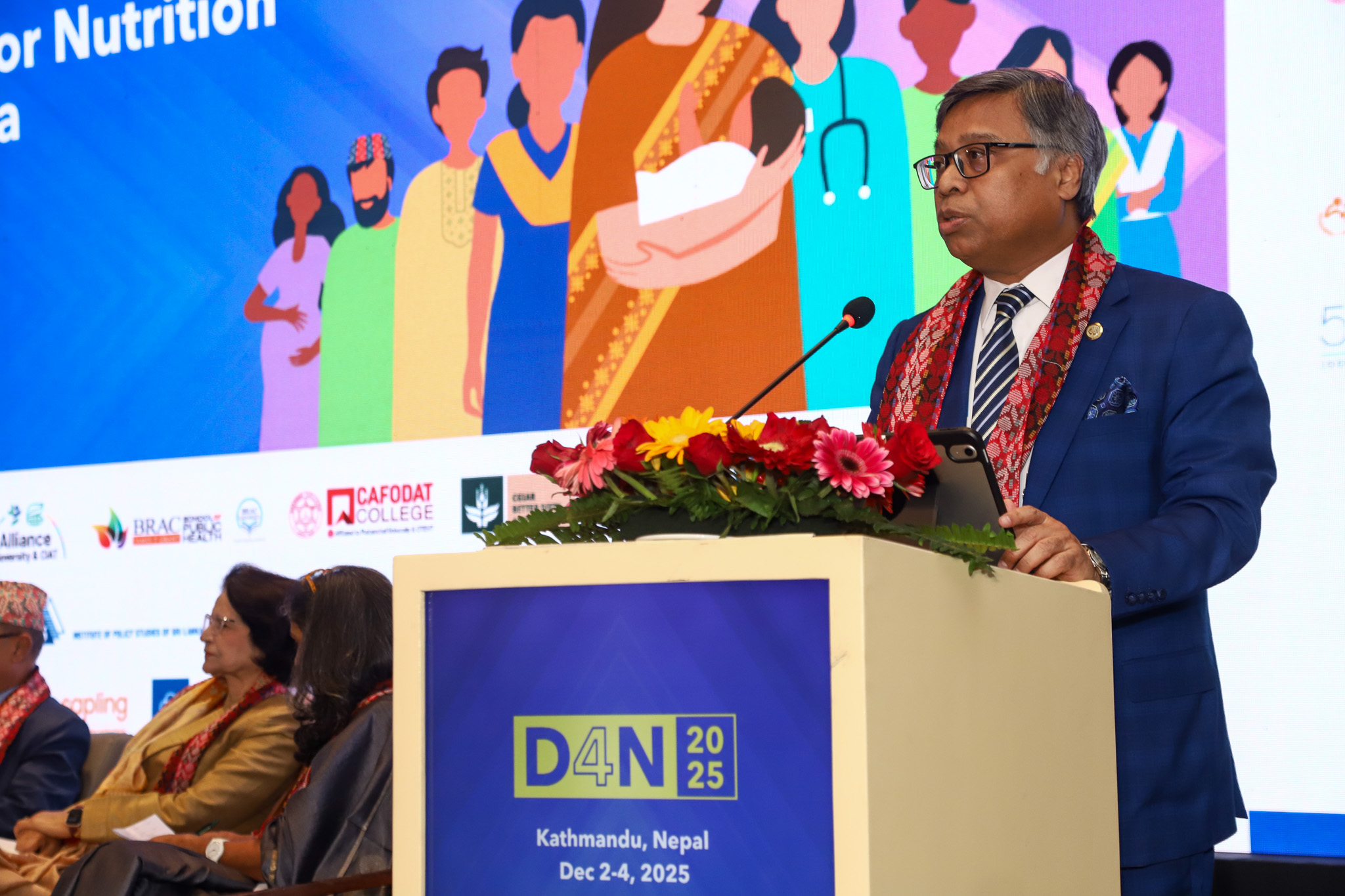
Ambassador Md. Golam Sarwar, Secretary General of the South Asian Association for Regional Cooperation (SAARC), attended the Delivering for Nutrition 2025 (D4N) Conference in Kathmandu, Nepal, as a Distinguished Guest at the Opening Session. The conference, convened under the theme “Towards Impact at Scale,” brought together policymakers, researchers, practitioners, and development partners from across South Asia and beyond to advance collective action on nutrition.
In his opening statement, the Secretary General expressed deep appreciation to the Government of Nepal for hosting the conference and to the International Food Policy Research Institute (IFPRI), CGIAR, and regional partners for convening this important dialogue. He underscored the urgency of addressing South Asia’s persistent nutrition challenges, noting that over one billion people in the region still cannot afford a healthy diet, a stark reminder of systemic gaps in food, health, and economic systems.
The Secretary General highlighted the interconnected nature of malnutrition, including anaemia, stunting, micronutrient deficiencies, and obesity, and emphasized the need for multi-sectoral, scalable, and evidence-based responses. He recalled the outcomes of the SAARC and UNICEF Regional Conference on Reducing Anaemia among Adolescent Girls and Women held earlier this year in Colombo, where IFPRI played a vital role in providing technical expertise and evidence to enrich regional dialogue.
The Secretary General welcomed the recently signed Memorandum of Understanding between IFPRI and the SAARC Agriculture Centre (SAC), describing it as a milestone in strengthening research cooperation, knowledge exchange, and joint action to improve food and nutrition security. Reflecting on SAARC’s longstanding mandate for regional cooperation, the Secretary General cited milestones such as the SAARC Charter (1985), the Social Charter (2004), and regional frameworks on nutrition and food security. He emphasized that the D4N Conference builds on this foundation by bringing science, policy, and practice together to drive impact at scale.
The Secretary General reaffirmed SAARC’s commitment to supporting Member States through its regional centres, technical committees, and collaborative mechanisms, particularly in data-sharing, capacity-building, and integrated approaches to nutrition.
The Secretary General stressed that future priorities must focus on scalability, sustainability, and equity, ensuring that interventions reach the most vulnerable populations, especially women, adolescent girls, and children. He noted that while progress is underway with Member States scaling up maternal health interventions, school-based nutrition programmes, and agri-food system reforms implementation remains uneven. Stronger systems, sustained financing, and accountability mechanisms are essential to translate commitments into measurable impact.
In conclusion, the Secretary General called for renewed determination to build a South Asia where every individual particularly women, adolescent girls, and children has access to nutritious, affordable food supported by resilient, inclusive, and equitable systems. He expressed confidence that the partnerships and commitments strengthened at D4N will help deliver transformative nutrition outcomes across the region.
SAARC Secretariat
Kathmandu, 2 December 2025